
ALL ARE WELCOME
St. Mary’s is a Catholic school community that strives for academic, emotional, and spiritual growth for all students.
We welcome students of all faiths!
WHY
ST. MARY’S SCHOOL

Small Classes
Our 10:1 teacher to student ratio provides individualized attention with staff that are dedicated to each and every student’s success.
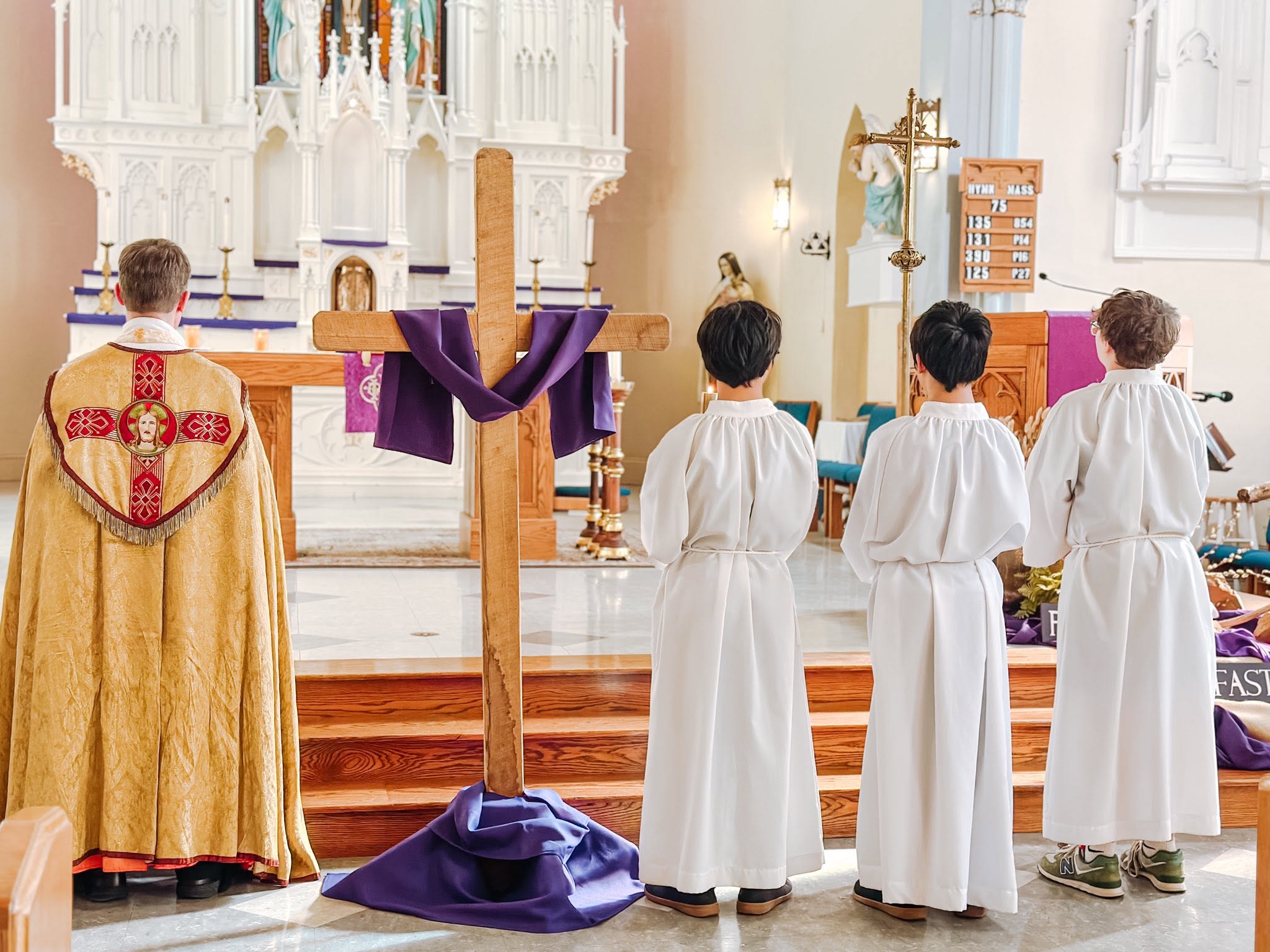
SPIRITUAL GROWTH & VALUES
SMS instills faith formation and values and provides many community activities and field trips outside of school.
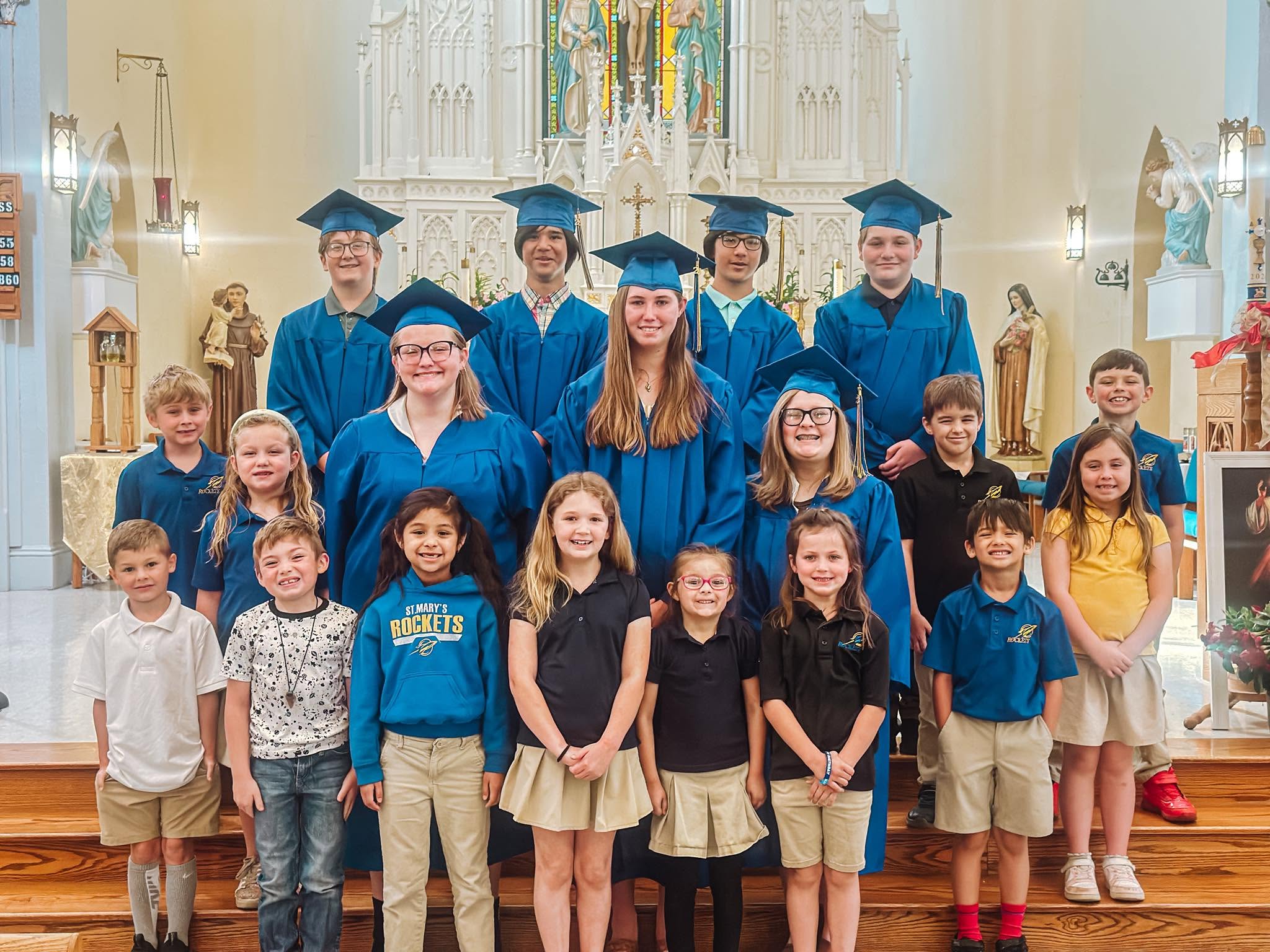
Academic EXCELLENCE
Passionate teachers use creative lessons to inspire students to achieve beyond their expectations

CONNECT
ST. MARY’S ON FACEBOOK
Page likes: 1,570
Saint Mary's Catholic School
(opens in a new tab)Saint Mary's School Official Facebook Page! Like and Follow to keep updated with all the latest school news and happenings!
+JMJ+SUNDAY BIBLICAL MASS READINGS AND QUESTIONSfor Self-Reflection, Couples or Family Discussion25th Sunday of Ordinary Time – Sunday, September 20th, 2026The First Reading - Isaiah 55:6-9Seek the LORD while he may be found, call him while he is near. Let the scoundrel forsake his way, and the wicked his thoughts; let him turn to the LORD for mercy; to our God, who is generous in forgiving. For my thoughts are not your thoughts, nor are your ways my ways, says the LORD. As high as the heavens are above the earth, so high are my ways above your ways and my thoughts above your thoughts.Reflection Sometimes this passage has been used to justify a distorted fideism (an overemphasis on faith that ignores reason and logic). The fideist says: “Why try to understand God and his ways? He’s incomprehensible. We should just accept everything on faith.” It’s true that understanding God poses difficulties, and that ultimately He is beyond what we can grasp with our rational faculties. However, the incomprehensibility of God, ironically, makes sense. We would not expect finite creatures to be able completely to comprehend an infinite, all-powerful, and all-wise being. If God is really who and what we believe Him to be, we would expect there to be a cognitive gap between His reality and our understanding of Him. Recognizing the gap between our understanding and the reality of God, the Church has nonetheless never advocated a dismissal of human reason from the life of faith. It must always be “faith seeking understanding,” and St. John Paul II dedicated his famous encyclical Fides et Ratio precisely to this issue. However, Isaiah 55:6-9 is not primarily making a philosophical argument about the intelligibility of the divine essence or actions. If we examine the context, we see that the discourse concerns God’s mercy toward the undeserving. Our Reading for today follows directly on that striking and beautiful passage in Isa 55:1-5, which promises a future experience in which the poor, hungry, and thirsty will be able to come to a free, divinely-provided banquet which will initiate them into the covenant God had made with David long ago. It is in the context of forgiveness and mercy that our text says, “my thoughts are not your thoughts … my ways are above your ways.”Adults - What helps you understand more about the Lord?Teens - Why is it understandable that we would not fully understand God?Kids - How can you grow in knowledge of God? Responsorial- Psalm 145:2-3, 8-9, 17-18 R.The Lord is near to all who call upon him.Every day will I bless you,and I will praise your name forever and ever.Great is the LORD and highly to be praised;his greatness is unsearchable.R. The Lord is near to all who call upon him.The LORD is gracious and merciful,slow to anger and of great kindness.The LORD is good to all and compassionate toward all his works.R. The Lord is near to all who call upon him.The LORD is just in all his waysand holy in all his works.The LORD is near to all who call upon him,to all who call upon him in truth.R. The Lord is near to all who call upon him. Reflection First Reading and the Psalm are to concepts of covenant and covenantal faithfulness. We saw how our First Reading, in context, follows closely upon an offer of a new, gracious, eternal covenant in Isaiah 55:1-3, in which the hesed or “covenantal love” of the Davidic covenant will be extended to all the poor who answer God’s call (Isa 55:3). Covenantal virtues of God are also extoled in Psalm 145, a Psalm that functions as a kind of preparation for the five “halleluiah” (Heb. “Praise” hallelu “the Lord” yah) Psalms with which the Psalter concludes. So, by the time we reach Psalm 145, we are beginning to “wrap up” the book of Psalms by trying to take in the “big picture” of God in relationship to his people, and sum up the message of this entire collection of sacred poems. How has God been faithful in your life?The Second Reading- Philippians 1:20C-24, 27ABrothers and sisters: Christ will be magnified in my body, whether by life or by death. For to me life is Christ, and death is gain. If I go on living in the flesh, that means fruitful labor for me. And I do not know which I shall choose. I am caught between the two. I long to depart this life and be with Christ, for that is far better. Yet that I remain in the flesh is more necessary for your benefit. Only, conduct yourselves in a way worthy of the gospel of Christ. Reflection - In a providential pun, St. Paul describes his life of ministry as “fruitful labor,” because he is, in a true sense, a faithful worker in the vineyard of the Lord, even one who has borne the heat of the day, although St. Paul would not be one to complain to receive the same “pay” as every other Christian. In fact, he would rejoice if so many could share in the same “salary” from the Lord. All Paul wants is Christ. To live is Christ, and to depart this life means to be with Christ. So “it’s all good.” He’s not looking forward to some kind of material benefit or carnal pleasure in heaven as a pay-off, a kind of eternal free ticket to the heavenly Disney World because he “put his time in the trenches.” No, Paul just wants communion with Christ. That is quite a contrast to the Gospel parable, where the workers don’t want a relationship with the vineyard owner, they want more pay. -Focus this week on putting the Lord first and letting all of your actions flow from that relationship.The Holy Gospel according to Matthew 20:1-16AJesus told his disciples this parable: “The kingdom of heaven is like a landowner who went out at dawn to hire laborers for his vineyard. After agreeing with them for the usual daily wage, he sent them into his vineyard. Going out about nine o’clock, the landowner saw others standing idle in the marketplace, and he said to them, ‘You too go into my vineyard, and I will give you what is just.’ So they went off. And he went out again around noon, and around three o’clock, and did likewise. Going out about five o’clock, the landowner found others standing around, and said to them, ‘Why do you stand here idle all day?’ They answered, ‘Because no one has hired us.’ He said to them, ‘You too go into my vineyard.’ When it was evening the owner of the vineyard said to his foreman, ‘Summon the laborers and give them their pay, beginning with the last and ending with the first.’ When those who had started about five o’clock came, each received the usual daily wage. So when the first came, they thought that they would receive more, but each of them also got the usual wage. And on receiving it they grumbled against the landowner, saying, ‘These last ones worked only one hour, and you have made them equal to us, who bore the day’s burden and the heat.’ He said to one of them in reply, ‘My friend, I am not cheating you. Did you not agree with me for the usual daily wage? Take what is yours and go. What if I wish to give this last one the same as you? Or am I not free to do as I wish with my own money? Are you envious because I am generous?’ Thus, the last will be first, and the first will be last.”Reflection The vineyard in this parable can be identified as “Israel,” based on Old Testament texts (Isa 5:1-7). Jesus’ choice of twelve apostles makes clear that in his ministry he is establishing a New Israel, a new community of God’s people. This community will consist as one people made up of both Jews and Gentiles (Matt 28:19; Eph 2:11-16). This new community is the manifestation on earth of the Kingdom of God, and it is also the “vineyard” of this parable. It comes to be called the ekklesia, the “gathering,” the Church. The Parable of the Workers in the Vineyard comes immediately after Peter’s request to know what the reward for the apostles will be (Matt 19:27). Thus, it can be interpreted as a warning against thinking of the Kingdom of Heaven in terms of personal reward: “What’s in it for me?” In the first sense, then, the vineyard is God’s Kingdom on earth, in our own age manifested as the Church. The workers in the vineyard are those the Lord calls to assist him in his labors: the apostles first, but in later generations their successors and others who work to “cultivate” and care for God’s Kingdom. A secondary application can be made to all Christians, for we are all called to care for and cultivate the Kingdom manifest as the Church, even if the only member of that body we ever are able to “help” or “cultivate” is our own self. The message of the parable then is clear: all who are called to work with the Lord to care for his Kingdom will receive the same reward: the “denarius” (“usual wage” in our Mass translation). The Fathers generally held that this “denarius” represents eternal life, the basic “pay” of all who heed the Master’s call to come into his vineyard. All workers will receive this reward equally.Adults - Do you operate with a “what’s in it for me?” mindset? How can you work against this? Teens - Are there things in your life causing you bitterness? Take them to the Lord in prayer. Kids - What does it mean that God loves us all equally?LIVING THE WORD OF GOD THIS WEEK! - Looking back on our past life, how many years have we really given to God since we came to the use of reason? Those school years, the time spent learning a trade or profession, the weeks, months, years working in an office or factory or farm, the hours among the pots and pans in the kitchen — have we earned some credit in heaven for all of this, or is it all crossed off our pay sheet through lack of right intention or through sin? If so, those years are lost to us. We were "idle" all that time. Today's parable, however, should give us new hope and courage. It may be the sixth or the ninth or even the eleventh hour of our life but we can still earn heaven if we listen to God's call and set to work diligently in His vineyard. If we put our conscience right with God today and resolve to be loyal to Him from now on He will be as generous to us, as the parable promises. -Excerpted from The Sunday Readings by Fr. Kevin O'Sullivan, O.F.M.
- Today Mrs. Susan Zimmerman from The Daughters of The American Revolution came by to talk to 2nd grade about The Constitution and our flag. She read them stories and answered the many questions they had! They were intrigued and asked questions about our flag, government and constitution the rest of the day! Thank you, Susan! 🇺🇸
